Our Cisco 300-110 exam questions will correct your learning problems with the help of the test engine. All contents of 300-110 training prep are made by elites in this area rather than being fudged by laymen. Let along the reasonable prices which attracted tens of thousands of exam candidates mesmerized by their efficiency by proficient helpers of our company. Any difficult posers will be solved by our Cisco 300-110 Quiz guide.
Cisco 300-110 Exam Syllabus Topics:
| Section | Weight | Objectives |
|---|---|---|
| Wireless Infrastructure Design | 30% | - Wired-wireless integration design
|
| WLAN High Availability and Security Design | 20% | - Management and monitoring design - Security architecture design
|
| Wireless Site Survey | 25% | - Design requirements collection and constraint evaluation
- RF propagation and attenuation analysis - Pre-deployment survey and validation |
| Mobility Design | 25% | - Guest mobility and BYOD design - Roaming optimization
|
300-110 Examcollection Free Dumps - Test 300-110 Simulator Online
We provide Cisco 300-110 web-based self-assessment practice software that will help you to prepare for the Cisco Designing Cisco Wireless Networks exam. Cisco 300-110 Web-based software offers computer-based assessment solutions to help you automate the entire Designing Cisco Wireless Networks exam testing procedure. The stylish and user-friendly interface works with all browsers, including Mozilla Firefox, Google Chrome, Opera, Safari, and Internet Explorer. It will make your Cisco Designing Cisco Wireless Networks exam preparation simple, quick, and smart. So, rest certain that you will discover all you need to study for and pass the Cisco 300-110 Exam on the first try.
Cisco Designing Cisco Wireless Networks Sample Questions (Q117-Q122):
NEW QUESTION # 117
Refer to the exhibit. A network engineer is designing a high availability SSO on a Cisco Catalyst
9800- 40 WLC with multi-LAG network redundancy on two Catalyst 9300 switches. The LAG requirements are: ?Each LAG must be connected to a single switch. ?Different VLANs must be assigned to different LAGs. ?The controller must learn the identity of partners that can support LAG capabilities in each port. ?When any active LAG ports fail, a standby LAG port must provide redundancy. Which protocol must be used for the port channel on the interface to meet the design requirements?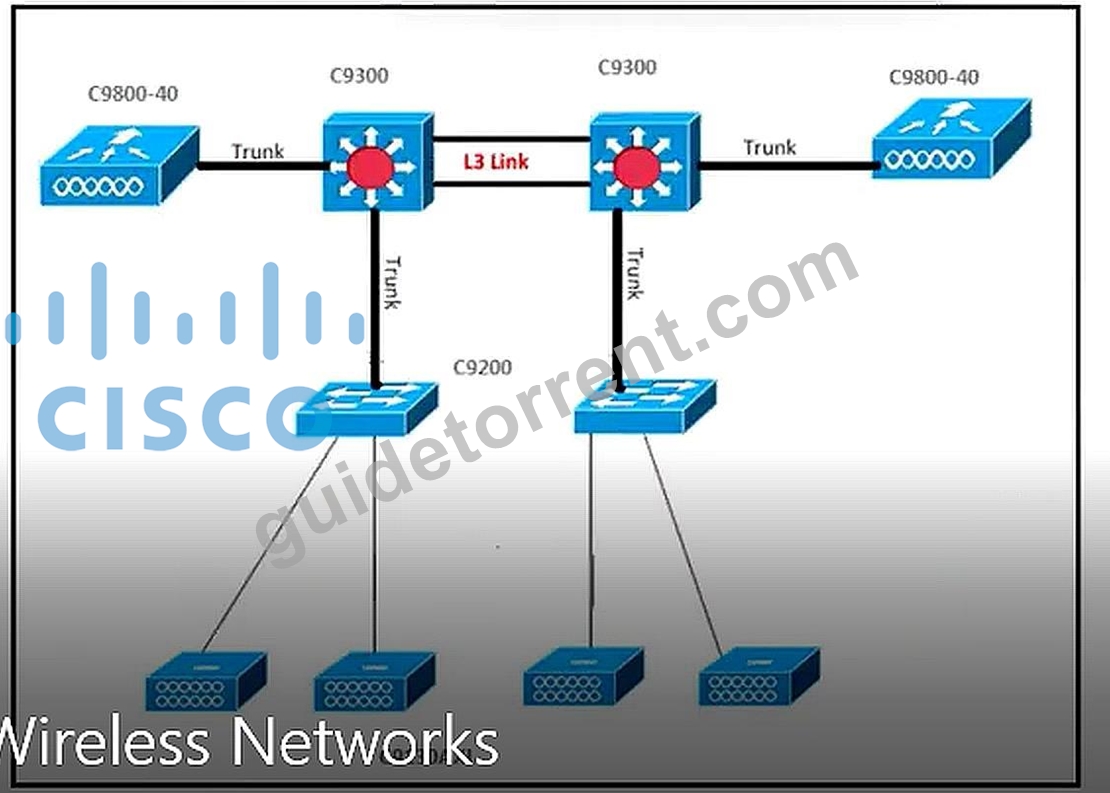
- A. PAgP
- B. LACP
- C. BGP
- D. OSPF
Answer: B
Explanation:
The design requirements specify a multi-LAG configuration where each LAG connects to a single switch, different VLANs are assigned to different LAGs, the controller must dynamically learn partner LAG capabilities per port, and standby ports provide redundancy upon active port failure.
These requirements collectively point to IEEE 802.3ad LACP (Link Aggregation Control Protocol) as the correct protocol. LACP is the industry-standard IEEE protocol that enables dynamic negotiation of LAG membership between endpoints -- the WLC and each Catalyst 9300 switch exchange LACP PDUs (LACPDUs) to discover port capabilities, negotiate bundle membership, and monitor link status. LACP supports active and passive port states where active ports initiate negotiation and passive ports respond, and it provides the standby port mechanism through its hot-standby capability for link redundancy within the bundle. The requirement to 'learn the identity of partners that can support LAG capabilities' is the defining characteristic of LACP's standardized PDU exchange mechanism.
NEW QUESTION # 118
A small customer has a legacy autonomous mode Wi-Fi deployment that provides a low-density and low- capacity service. The customer wants to update and replace this deployment with the latest Wi-Fi technology but has a fixed budget that will pay only to replace the APs. Which architectural controller deployment model suits this requirement?
- A. unified
- B. embedded
- C. fabric
- D. cloud
Answer: B
Explanation:
Cisco ' s Embedded Wireless Controller (EWC) architecture is the ideal solution for small deployments with strict budget constraints where only the access points can be replaced. EWC is a controller function that runs directly within the Cisco Catalyst 9100 Series access point itself - eliminating the need for a dedicated physical or virtual WLC appliance. The APs serve dual roles as both the wireless radio infrastructure and the controller platform. The unified model (Option B) requires a dedicated hardware WLC such as the 9800 series, exceeding the customer ' s budget. Fabric (Option C) requires Cisco DNA Center and SD-Access infrastructure, making it cost-prohibitive for a small deployment. Cloud (Option D) requires ongoing subscription fees that may not fit a fixed one-time budget. EWC provides enterprise-grade features including centralized SSID management, RRM, and client mobility within the AP cluster - all without additional controller hardware investment. This makes it the canonical solution for SMB migrations from autonomous deployments. Reference: WLSD Study Guide - Controller Deployment Models, Embedded Wireless Controller Architecture, SMB and Branch Wireless Design.
NEW QUESTION # 119
Multiple WLCs are implemented in a high-availability configuration in a mobility group. APs are deployed with only a primary controller assigned. By default, which mobility group member controller do the orphaned APs join in the event of a failed controller?
- A. controller with the least CPU utilization over the last reporting period
- B. controller with the most available AP free license capacity
- C. controller with the lowest percent of associated APs per license capacity
- D. controller with the least number of associated APs
Answer: C
Explanation:
In a high-availability configuration with multiple WLCs in a mobility group, when APs that only have a primary controller configured become orphaned (their primary WLC fails), they will by default join the controller with the lowest percentage of associated APs per license capacity. This load-based selection mechanism ensures a balanced distribution of APs across the remaining controllers in the mobility group. The WLC with the lowest percentage of AP capacity utilized is chosen because it has the most headroom to accept additional APs without becoming overloaded. This prevents a single backup controller from becoming overwhelmed while others remain underutilized. The selection is not based on absolute number of APs (Option D), available free licenses in absolute terms (Option A), or CPU utilization (Option C) - it specifically uses the percentage of license capacity occupied, which normalizes across controllers with different total AP capacities. Reference: WLSD Study Guide - N+1 Redundancy Default Behavior, AP Orphan Failover Logic, WLC Load-Based AP Assignment.
NEW QUESTION # 120
A consultant must design a WLAN for a large campus with high AP density, 50-100 clients per cell, 5 Mbps throughput per client minimum, 5 GHz and 2.4 GHz coverage at -67 dBm, and no 802.11b clients. Which two WLAN design approaches meet the requirements? (Choose two.)
- A. Reduce the 2.4 GHz coverage with FRA.
- B. Enable 802.11b data rates.
- C. Set the 5 GHz channel widths to 80-160 MHz.
- D. Configure up to six SSIDs on any AP.
- E. Set the minimum mandatory data rates to 12-18 Mbps.
Answer: A,E
Explanation:
Designing for 50-100 clients per cell with 5 Mbps minimum throughput and no 802.11b clients requires two critical optimizations. First, setting minimum mandatory data rates to 12-18 Mbps (Option A) removes legacy lower data rates from the AP ' s supported rate set. When 1, 2, 5.5, and 11 Mbps rates are disabled and 12 Mbps becomes the minimum mandatory rate, legacy 802.11b clients are excluded from the cell, airtime efficiency improves dramatically, and clients connecting at higher rates use less channel time per frame, increasing effective capacity. Second, Flexible Radio Assignment (FRA) for 2.4 GHz reduction (Option D) is critical in high-density environments. FRA allows the WLC to dynamically reassign some 2.4 GHz radios to 5 GHz operation or monitor mode, reducing 2.4 GHz cell size and interference while increasing 5 GHz capacity in the high-density area. Option C directly contradicts the no-802.11b requirement. Option B (6 SSIDs per AP) is a management consideration but does not directly address throughput. Option E (80-160 MHz channels) would consume available spectrum, reducing the number of usable non-overlapping channels and worsening co-channel interference at high density. Reference: WLSD Study Guide - High-Density WLAN Design, Minimum Data Rate Configuration, Flexible Radio Assignment (FRA).
NEW QUESTION # 121
An engineer is using Ekahau Site Survey to create a WLAN plan for a warehouse. The plan is to use patch antennas. Which setting is adjusted when simulated APs are placed on the map?
- A. AP transmission power
- B. antenna downtilt
- C. Wi-Fi technology
- D. AP channel
Answer: B
Explanation:
In Ekahau Site Survey, when planning a warehouse deployment using patch (directional) antennas, the antenna downtilt setting is the critical adjustment made when placing simulated APs on the floor plan map. Patch antennas have a defined radiation pattern with a main lobe that must be aimed precisely at the intended coverage zone. In a warehouse environment, APs with patch antennas are typically wall-mounted and aimed down aisles. The downtilt angle determines the vertical component of the antenna's aim -- adjusting the downtilt in Ekahau tilts the simulated antenna's main radiation lobe downward toward the warehouse floor and the working zone of RF scanner devices, rather than projecting RF energy horizontally at an ineffective angle. Ekahau allows engineers to specify the horizontal and vertical orientation of the antenna in three dimensions, and the downtilt value directly controls how the software models the antenna's coverage pattern in the vertical plane.
NEW QUESTION # 122
......
The 300-110 PDF is the collection of real, valid, and updated Designing Cisco Wireless Networks (300-110) practice questions. The Cisco 300-110 PDF dumps file works with all smart devices. You can use the 300-110 PDF questions on your tablet, smartphone, or laptop and start 300-110 Exam Preparation anytime and anywhere. The 300-110 dumps PDF provides you with everything that you must need in 300-110 exam preparation and enable you to crack the final 300-110 exam quickly.
300-110 Examcollection Free Dumps: https://www.guidetorrent.com/300-110-pdf-free-download.html
- What Makes Cisco 300-110 Exam Dumps Different? 🥧 Download “ 300-110 ” for free by simply entering ( www.dumpsmaterials.com ) website ➰300-110 Valid Exam Papers
- 300-110 Book Free 👡 Practice Test 300-110 Fee 🧃 300-110 Book Free ✈ Easily obtain free download of ☀ 300-110 ️☀️ by searching on ⇛ www.pdfvce.com ⇚ 🕌New 300-110 Exam Bootcamp
- 100% Pass Professional Cisco - 300-110 - Test Designing Cisco Wireless Networks Collection 👟 Go to website 【 www.examcollectionpass.com 】 open and search for ➤ 300-110 ⮘ to download for free 🐜Flexible 300-110 Learning Mode
- What Makes Cisco 300-110 Exam Dumps Different? ⚡ Search for ⇛ 300-110 ⇚ on 「 www.pdfvce.com 」 immediately to obtain a free download 🤎Test 300-110 Result
- New 300-110 Exam Bootcamp 🙅 300-110 New Exam Braindumps 👡 Latest 300-110 Exam Topics 🍶 Search for [ 300-110 ] and download it for free immediately on ( www.prepawaypdf.com ) 📏300-110 Valid Exam Fee
- 300-110 Valid Exam Fee 🐰 Knowledge 300-110 Points 🧁 Knowledge 300-110 Points 🐣 Enter [ www.pdfvce.com ] and search for 「 300-110 」 to download for free 🚑Knowledge 300-110 Points
- Knowledge 300-110 Points 🦈 300-110 Valid Exam Fee 🎅 Flexible 300-110 Learning Mode 📲 Search for ✔ 300-110 ️✔️ and easily obtain a free download on ▛ www.prepawayexam.com ▟ 📔300-110 New Exam Braindumps
- Pass Guaranteed Quiz 2026 Cisco 300-110: Efficient Test Designing Cisco Wireless Networks Collection 🧲 Search for 「 300-110 」 and download it for free immediately on ✔ www.pdfvce.com ️✔️ 👆300-110 Valid Exam Papers
- Exam 300-110 Voucher 👧 300-110 Training Courses 🌺 Valid 300-110 Exam Prep 👒 Search for ☀ 300-110 ️☀️ and download it for free on ➠ www.practicevce.com 🠰 website 💚Latest 300-110 Exam Topics
- Test 300-110 Result 🍮 Exam 300-110 Voucher 🌁 300-110 Book Free 🧰 The page for free download of ▛ 300-110 ▟ on ➽ www.pdfvce.com 🢪 will open immediately ☑300-110 Valid Exam Fee
- 100% Pass Professional Cisco - 300-110 - Test Designing Cisco Wireless Networks Collection Ⓜ Enter 《 www.dumpsmaterials.com 》 and search for [ 300-110 ] to download for free ⏪Latest 300-110 Exam Materials
- myportal.utt.edu.tt, myportal.utt.edu.tt, myportal.utt.edu.tt, myportal.utt.edu.tt, myportal.utt.edu.tt, myportal.utt.edu.tt, myportal.utt.edu.tt, myportal.utt.edu.tt, myportal.utt.edu.tt, myportal.utt.edu.tt, myportal.utt.edu.tt, myportal.utt.edu.tt, myportal.utt.edu.tt, myportal.utt.edu.tt, myportal.utt.edu.tt, myportal.utt.edu.tt, myportal.utt.edu.tt, myportal.utt.edu.tt, myportal.utt.edu.tt, myportal.utt.edu.tt, myportal.utt.edu.tt, myportal.utt.edu.tt, myportal.utt.edu.tt, myportal.utt.edu.tt, myportal.utt.edu.tt, myportal.utt.edu.tt, myportal.utt.edu.tt, myportal.utt.edu.tt, myportal.utt.edu.tt, myportal.utt.edu.tt, myportal.utt.edu.tt, myportal.utt.edu.tt, myportal.utt.edu.tt, myportal.utt.edu.tt, myportal.utt.edu.tt, myportal.utt.edu.tt, myportal.utt.edu.tt, myportal.utt.edu.tt, myportal.utt.edu.tt, myportal.utt.edu.tt, connect.garmin.com, myportal.utt.edu.tt, myportal.utt.edu.tt, myportal.utt.edu.tt, myportal.utt.edu.tt, myportal.utt.edu.tt, myportal.utt.edu.tt, myportal.utt.edu.tt, myportal.utt.edu.tt, myportal.utt.edu.tt, myportal.utt.edu.tt, myportal.utt.edu.tt, myportal.utt.edu.tt, myportal.utt.edu.tt, myportal.utt.edu.tt, myportal.utt.edu.tt, myportal.utt.edu.tt, myportal.utt.edu.tt, myportal.utt.edu.tt, myportal.utt.edu.tt, myportal.utt.edu.tt, portfolium.com, www.stes.tyc.edu.tw, link.woomy.me, www.stes.tyc.edu.tw, rare-books.library.sites.carleton.edu, www.stes.tyc.edu.tw, Disposable vapes

Powered by
